← Home · Ground improvement

Vibrocompaction Design Services in Markham

Together, we solve the challenges of tomorrow.

LEARN MORE →

The National Building Code of Canada sets clear expectations for foundation performance, but achieving them in Markham means contending with the legacy of glacial Lake Markham. Much of the city sits on deposits of loose silty sand and soft clay that can densify unevenly under load. A vibrocompaction design that simply applies textbook parameters without accounting for the layered stratigraphy north of Highway 7 or the more cohesive pockets near the Rouge River basin will underperform. In our experience, the difference between a routine job and a resilient one lies in the pre-treatment investigation. Before specifying probe spacing and energy input, we often pair the design with an in-situ permeability test to confirm drainage capacity, because trapped pore pressure is the fastest way to sabotage a compaction program in these soils.

In Markham's glacial till, the success of vibrocompaction hinges on matching probe energy to the fines content — not just the blow count.

Process and scope

A common oversight we see in Markham is treating vibrocompaction as purely a liquefaction mitigation tool, while ignoring its role in controlling total and differential settlement under static loads. The silty fine sands found across the Duffin Creek watershed do not always trigger liquefaction concerns under the seismic hazard values in NBCC 2020, but they can settle by several centimeters when saturated and subjected to footing pressures from mid-rise structures. A solid vibrocompaction design maps the target relative density to the actual gradation of the deposit: we use grain size curves from the grain-size analysis to calibrate the required energy per probe, ensuring the post-treatment cone resistance meets the project's bearing capacity criteria. This approach avoids the costly over-design of assuming clean sand behavior in deposits that are actually transitional silts, while also preventing under-densification that leads to post-construction distress in slab-on-grade floors and buried utilities.
Vibrocompaction Design Services in Markham
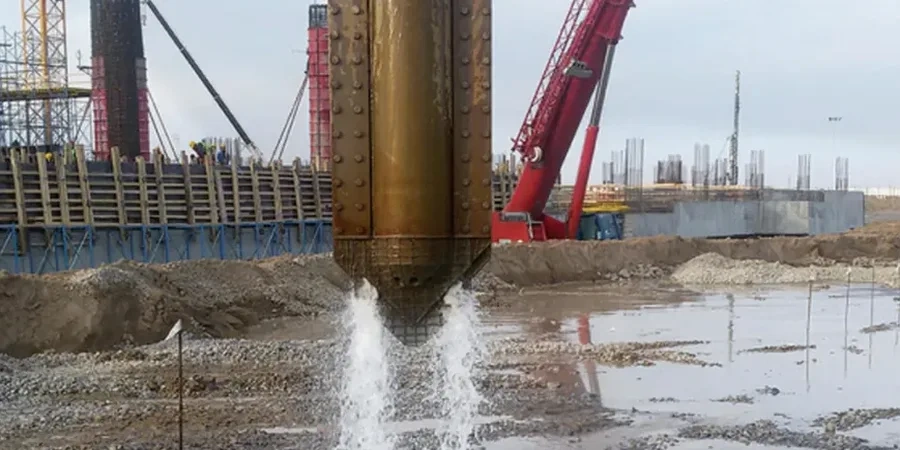
Technical reference image — Markham

Local ground factors

Markham's transformation from farmland to a high-density tech and residential hub has accelerated the redevelopment of parcels that were never engineered for modern structural loads. The older industrial subdivisions along Woodbine Avenue and the newer townhouse clusters east of Markham Road often sit on fill of variable thickness, placed without controlled compaction decades ago. A vibrocompaction design that does not account for this anthropogenic layer risks creating a stiff crust over an uncompacted core: the ground improvement works beautifully at shallow depth but leaves a soft horizon underneath that continues to consolidate over time. The consequence is differential movement between pile-supported elements and grade-supported slabs. We address this by specifying staggered probe depths and verifying the energy transfer through the fill using instrumented vibrators, correlating the results back to the site-specific CPT baseline established during the investigation phase.

Need a geotechnical assessment?

Reply within 24h.

Email: info@geotechnicalengineering.co

Reference parameters

ParameterTypical value
Applicable standardCSA A23.3, NBCC 2020
Soil typeLoose sands, silty sands
Depth of treatmentUp to 25 m
Target relative density70–85% Dr
Probe typesElectric or hydraulic vibrators
Quality control methodPre- and post-CPT correlation
Settlement reduction0.5–2.0 cm typical

Related services

01

Pre-treatment CPT Investigation

Detailed cone penetration testing to map the vertical and lateral extent of loose zones, identify the water table, and establish the baseline tip resistance and sleeve friction values for compaction targets.

02

Vibrocompaction Design Package

Probe grid layout, energy input specifications, stage sequence and withdrawal rates, all calibrated to the grain size distribution and fines content of the site.

03

Post-treatment Verification Testing

Repeat CPT and select SPT borings after compaction to confirm that the target relative density has been achieved across the full treatment depth and area.

04

Settlement Monitoring Plan

Installation of settlement plates and monitoring schedules to track post-treatment consolidation, providing documentation for municipal permit closure and structural warranty requirements.

Applicable standards

NBCC 2020 – National Building Code of Canada, CSA A23.3 – Design of Concrete Structures, ASTM D6066 – Standard Practice for Determining the Normalized Penetration Resistance of Sands for Evaluation of Liquefaction Potential, ASTM D5778 – Standard Test Method for Electronic Friction Cone and Piezocone Penetration Testing of Soils, OPSS.MUNI 206 – Ontario Provincial Standard Specification for Granular Base and Sub-Base

Frequently asked questions

How much does a vibrocompaction design cost for a typical Markham site?

The design package, including pre-treatment CPT investigation, analysis, and the final compaction specification, typically ranges from CA$1,840 to CA$6,380. The total depends on the site area, the depth of the loose deposit, and the number of probe locations required to characterize the variability of the soil.

What makes Markham soils different for vibrocompaction compared to Toronto?

Markham's subsurface is heavily influenced by glacial Lake Markham deposits, which created extensive layers of silty sand and rhythmically bedded silt and clay. These soils tend to have higher fines content than the cleaner sands found in some Toronto till deposits, which means the vibrator frequency and probe spacing need adjustment to allow pore pressure dissipation during compaction.

Does vibrocompaction eliminate the need for deep foundations in Markham?

In many cases, vibrocompaction can densify the upper 10 to 25 metres sufficiently to support shallow footings or a mat foundation for low- to mid-rise buildings. However, if the compressible clay layers extend deeper than the practical reach of the vibrator, a combined solution with piles or stone columns may be more appropriate. The decision is always based on the post-treatment CPT results.

How is the quality of vibrocompaction verified on a Markham project?

Quality control relies on a before-and-after comparison using cone penetration testing. We establish a baseline CPT profile before treatment, execute the vibrocompaction according to the design grid and energy parameters, and then perform a second series of CPT soundings at the same locations. The increase in tip resistance and sleeve friction, along with the reduction in pore pressure ratio, confirms the achieved densification.
Location and service area

We serve projects in Markham and surrounding areas.

View larger map