← Home · Roadway

Rigid Pavement Design in Markham: Concrete Solutions for Ontario's Frost Climate

Together, we solve the challenges of tomorrow.

LEARN MORE →

Markham’s position on the South Slope of the Oak Ridges Moraine creates a unique pavement environment where silty sand till and clay plains meet 1.2-meter frost penetration depths. The freeze-thaw cycles here are relentless, and a rigid pavement design that ignores local subgrade moisture will spall within three winters. We approach every project—from Highway 7 commercial plazas to Rouge Valley infrastructure—by mapping the soil-water interaction first. A test pit investigation lets us verify the stratigraphy below the proposed grade, which is critical because the Halton Till underlying much of Markham can shift from dense to highly weathered within a few meters. This initial step defines whether the concrete slab will act as a true structural layer or become a maintenance liability.

In Markham's frost-susceptible tills, a rigid pavement is only as reliable as the drainage layer beneath it.

Process and scope

The glacial geology across Markham deposits a heterogeneous mix of silty clay tills and interglacial sand lenses that complicate uniform support. In the Cornell and Greensborough areas, we often encounter moisture-sensitive soils where the modulus of subgrade reaction (k-value) can drop significantly after spring thaw. A proper rigid pavement design here requires more than just a thickness calculation; it demands a mechanistic-empirical approach that accounts for edge stresses and curling during the rapid temperature drops common in York Region. Before finalizing the dowel layout, we frequently correlate the subgrade response with a plate load test to capture the actual in-situ stiffness, especially when the water table is within 2 meters of the surface. Joint spacing is then tailored to the thermal coefficient of the local aggregate source, preventing uncontrolled mid-panel cracking during the January cold snaps that regularly push ambient temperatures below -15°C.
Rigid Pavement Design in Markham: Concrete Solutions for Ontario's Frost Climate
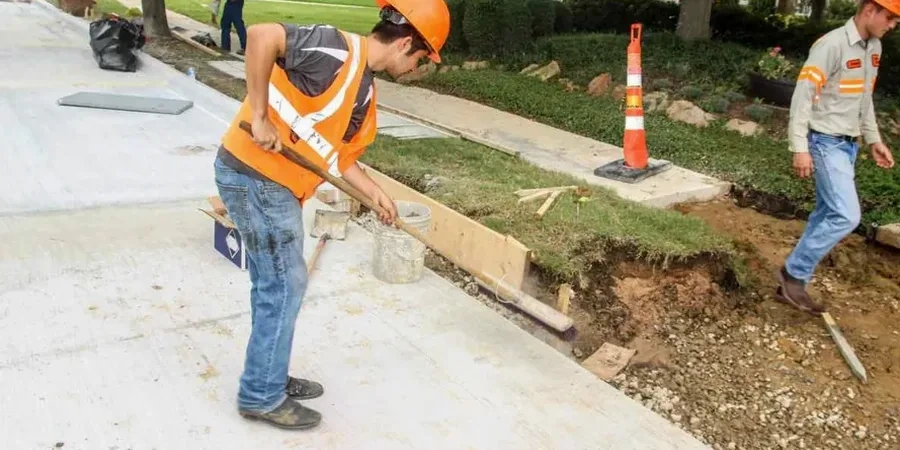
Technical reference image — Markham

Local ground factors

A warehouse project near Woodbine Avenue taught us a hard lesson about Markham’s micro-drainage. The design called for a standard 200 mm slab on a dense-graded base, but the contractor omitted the positive side drain where the grade transitioned into a silty clay pocket. After two winters, the trapped moisture froze, heaved the corner joints by 18 mm, and forklift traffic shattered the panels. The repair cost exceeded the original rigid pavement design budget by a factor of three. This failure mode—subsurface water entrapment under an impervious concrete surface—is the most common risk in the Greater Toronto Area. Mitigation demands a daylighted drainage layer and strict QA/QC on the base compaction, confirmed through sand cone density testing before the first concrete truck arrives.

Need a geotechnical assessment?

Reply within 24h.

Email: info@geotechnicalengineering.co

Reference parameters

ParameterTypical value
Design StandardCSA A23.3 / ACPA StreetPave / PCA
Typical Concrete Strength32–35 MPa flexural (MR)
Frost Depth Consideration1.2 m minimum per Ontario Building Code
Subgrade Evaluationk-value via plate load or CBR correlation
Joint Spacing24–36 x slab thickness (plain jointed)
Base LayerOpen-graded granular (OGDL) or dense-graded 19 mm
Load TransferDowel bars (round, epoxy-coated) per OPSS 351

Related services

01

Industrial Concrete Floor Slabs

Design for high-rack warehouse loads, narrow-aisle forklifts, and automated guided vehicles (AGVs) using Westergaard or finite element analysis. We specify steel fiber reinforcement and shrinkage-compensating admixtures where joint-free performance is required.

02

Municipal Roadway & Intersection Design

Pavement structural design following the MTO mechanistic-empirical method, including tied concrete shoulders, bus pad reinforcement, and roundabout aprons that resist heavy vehicle turning stresses.

Applicable standards

CSA A23.3: Design of Concrete Structures, Ontario Provincial Standard Specification (OPSS) 350 / 351, Ontario Building Code (OBC) – Frost Protection Requirements, ASTM C78 / C1435 (Flexural Strength & Maturity)

Frequently asked questions

What is the typical cost range for a rigid pavement design package in Markham?

For a standard commercial or industrial project, the design package including subgrade investigation, k-value determination, and jointing plan typically ranges from CA$2,190 to CA$9,660. The final figure depends on the slab area, traffic spectrum, and the complexity of the subgrade conditions across the site.

How does Ontario's frost depth affect the rigid pavement design?

The 1.2-meter frost depth in Markham requires a non-frost-susceptible base layer that extends below the penetration line or a positive drainage system that prevents water saturation. We design the subbase to act as a capillary break, using open-graded stone wrapped in geotextile to maintain structural integrity through freeze-thaw cycles.

When is a plate load test necessary for a concrete pavement project?

A plate load test becomes essential when the subgrade contains variable fill or when the project involves heavy post loads, such as rack legs exceeding 10 kips. It gives us the direct modulus of subgrade reaction (k-value) that correlation tables from SPT blow counts cannot reliably provide in Markham’s mixed glacial soils.

Location and service area

We serve projects in Markham and surrounding areas.

View larger map