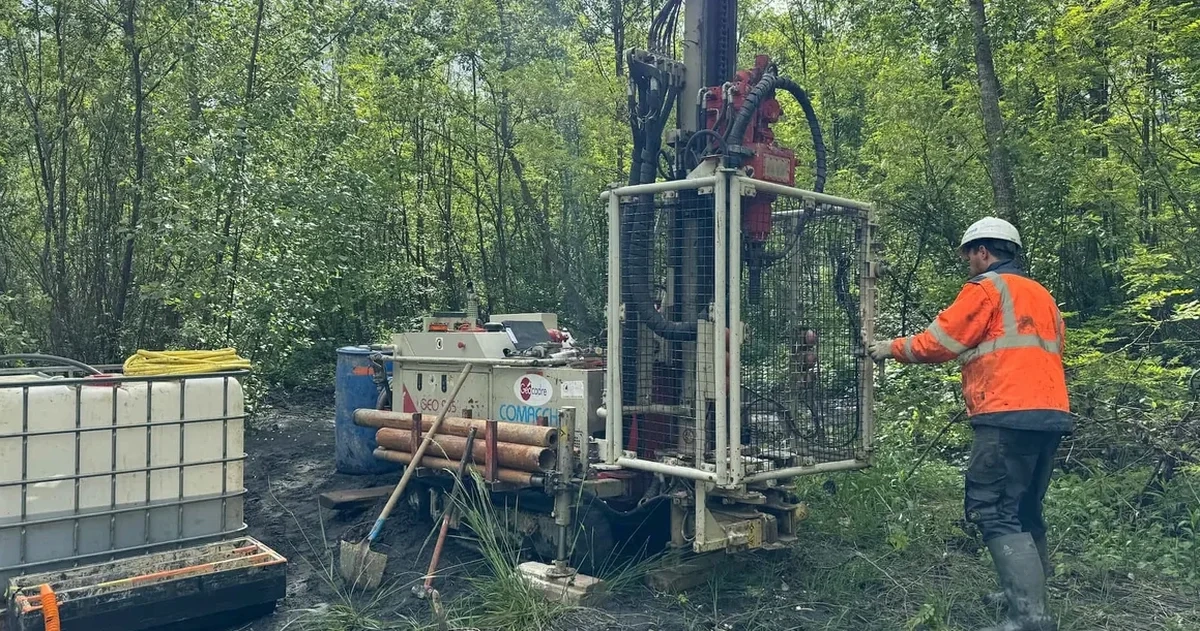
A truck-mounted drill rig with a 140-pound safety hammer drives the split-spoon sampler into the ground, recording the number of blows per foot. In Markham, that number often changes dramatically between 2 and 5 meters depth as the auger cuts through weathered till into the Halton Till beneath. Our soil mechanics study starts exactly there, reading the transition from loose silty sand to dense glacial diamict that dominates the Rouge River watershed. The data feeds directly into foundation design for projects across Unionville, Thornhill, and Cornell, where the subsurface tells a story shaped by the last ice age. We pair field logging with a full laboratory suite accredited to ISO 17025 for index and strength testing. A triaxial shear test on an undisturbed Shelby tube sample gives the drained friction angle that a shallow footing needs, while a grain size analysis quantifies the silt content that controls frost susceptibility under Markham's 1.5-meter frost penetration depth.
Markham's glacial stratigraphy can change bearing capacity by a factor of three across a single residential lot, making a site-specific soil mechanics study the only reliable path to foundation design.
Process and scope
A common mistake in the Greater Toronto Area is treating the upper crust of desiccated clay as a competent bearing layer without checking what lies beneath. In Markham subdivisions near Highway 7, that crust can sit over soft, high-plasticity glaciolacustrine clay with undrained shear strength below 40 kPa. A proper soil mechanics study sections the stratigraphy into design units: crust, soft clay, stiff till, and sometimes a deep sand aquifer. We run
Atterberg limits on each cohesive unit to classify the plasticity range, and consolidate samples in an oedometer to estimate settlement under the design load. The Ontario Building Code references geotechnical investigation requirements that tie directly to Part 4 structural design, and our reports follow that sequence from field log to bearing capacity recommendation. Where the till is dense and the clay is thin, a
plate load test can verify stiffness in situ, giving the structural engineer a measured modulus of subgrade reaction instead of a textbook assumption. Markham's topography adds another variable: the difference in elevation from the Rouge River floodplain to the Oak Ridges Moraine slope means two lots 500 meters apart can have completely different soil profiles, so we never copy-paste a report across adjacent addresses.
FAQ
What does a soil mechanics study cost in Markham?
For a typical single-family residential lot in Markham, a soil mechanics study including one borehole, SPT logging, lab testing, and a sealed report runs between CA$4,050 and CA$7,650. The range depends on access conditions, borehole depth, and the number of samples sent to the lab. Commercial projects with multiple boreholes and advanced testing fall at the higher end.
How deep do you drill for a Markham residential foundation?
Most residential boreholes in Markham reach between 8 and 15 meters below grade. We drill deep enough to penetrate the full thickness of any soft clay and confirm the bearing stratum in the Halton Till or equivalent dense deposit. The Ontario Building Code requires investigation to a depth where the stress increase from the foundation is less than 10 percent of the in-situ effective stress.
How long does the report take after field work?
Standard turnaround is 10 to 14 business days after the completion of field work. This allows time for consolidation and triaxial testing in the lab, data reduction, analysis, and Professional Engineer review before the sealed geotechnical report is delivered.
Can you test for frost heave potential in Markham's soils?
Yes. We run grain size distribution and hydrometer tests to determine the silt and fine sand fraction, then classify the soil per the USCS system as referenced by the Canadian Foundation Engineering Manual. Soils with more than 10 percent finer than 0.02 mm and low plasticity are flagged as frost-susceptible. Markham's frost penetration depth of approximately 1.5 meters makes this a standard part of our investigation.