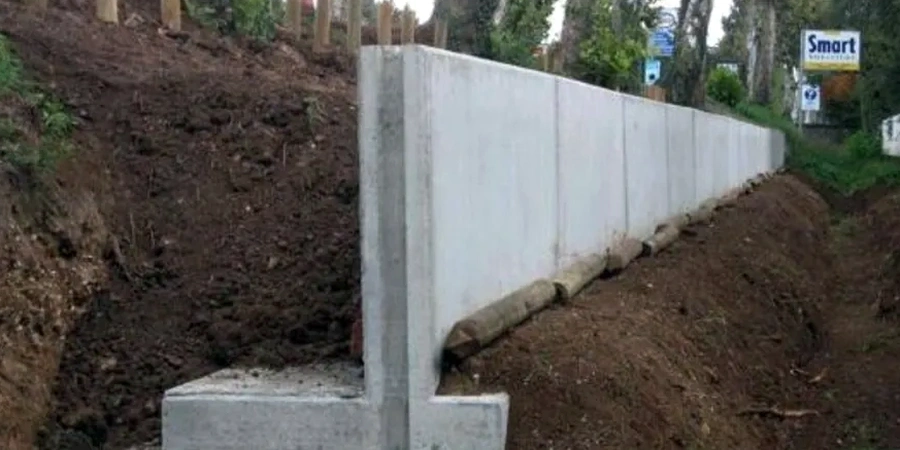
A recent excavation off Woodbine Avenue exposed a classic Markham profile: two meters of compacted silty fill over stiff Halton Till, with a perched water table at 1.8 meters depth. The developer needed a cantilever wall for a three-level underground parking structure, but the interface between the fill and the native till created a slip plane that standard prescriptive designs would have missed. Our team mobilized within 48 hours to extract Shelby tube samples for triaxial testing, then modeled the wall section using active earth pressure coefficients calibrated to the till's effective friction angle of 34 degrees. Markham sits within the Rouge River watershed, where valley slopes and post-glacial lacustrine clays demand more than a generic design table. We pair site-specific CPT testing with laboratory strength envelopes to establish the drained and undrained parameters that govern wall stability. For deeper cuts near the Oak Ridges Moraine, we often recommend integrating anchors into the design to resist overturning moments without excessive heel width.
A retaining wall in Markham's Halton Till without a drainage plan is a future liability—hydrostatic pressure can double the lateral thrust on the stem.
Process and scope
Markham's winter freeze-thaw cycles, with air temperatures dropping below -15°C in January, impose a frost penetration depth of 1.2 meters per NBCC climatic data. This depth dictates the minimum embedment for any wall stem, and it governs the granular backfill specification behind the wall. We specify clear crushed 19 mm stone wrapped in non-woven geotextile to prevent fines migration, ensuring that weep holes remain functional through spring thaw when groundwater levels peak. In the northern reaches of the city near the Oak Ridges Moraine, sandy silt tills exhibit higher permeability; here we design with a drained parameter set and verify using
triaxial testing on undisturbed samples. The contrast with the glaciolacustrine clays in the southern concessions is stark—those materials require total stress analysis with undrained shear strengths often below 50 kPa. For walls exceeding 3 meters in retained height, Markham's building department requires a sealed geotechnical report demonstrating compliance with the NBCC 2020 limit states framework. Our analysis covers sliding, overturning, bearing capacity, and global stability, the latter often checked using
slope stability modeling along critical cross-sections.
Local ground factors
Markham registered a population of 338,503 in the 2021 census, and with the York Region intensification targets, construction pressure on marginal terrain continues to grow. The primary geotechnical hazard for wall design here is not seismic—the city sits in a moderate seismicity zone with a 2% in 50-year spectral acceleration of 0.33g—but rather the seasonal volumetric instability of the near-surface soils. The Halton Till, while competent when confined, contains lenses of silt and sand that can pipe water during excavation, leading to loss of ground behind the wall and progressive settlement of adjacent infrastructure. A second hazard is the presence of undocumented fill in older commercial corridors along Highway 7; these fills often contain boulders, brick fragments, and organic debris that compromise backfill drainage and concentrate lateral loads unpredictably. Without a thorough test pit investigation to characterize the backfill zone before design, the wall may expertise differential movement at the joints, cracking of the stem, or tilt that exceeds the serviceability limit of 1:200 specified in typical performance criteria.
FAQ
What is the typical design fee range for a retaining wall in Markham?
For a standalone residential or small commercial wall, the design fee typically ranges from CA$1,240 to CA$4,960 depending on retained height, surcharge complexity, and whether a site investigation is already available. Larger multi-tier or shoring walls exceed that range.
Does Markham require a professional engineer to seal retaining wall drawings?
Yes. Under the Ontario Building Code and the City of Markham's permit requirements, any retaining wall exceeding 1.0 meter in height or supporting a surcharge must be designed and sealed by a professional engineer licensed with the Professional Engineers Ontario.
What soil parameters are most critical for wall design in the Halton Till?
Effective friction angle (φ') typically 32–36°, cohesion intercept (c') 0–5 kPa for drained analysis, and undrained shear strength (Su) 50–150 kPa when total stress governs. The key decision is whether to use drained or undrained parameters, which depends on the loading rate and drainage conditions during construction.