← Home · Laboratory

Grain Size Analysis for Geotechnical Projects in Markham, ON

Together, we solve the challenges of tomorrow.

LEARN MORE →

Compliance with the Ontario Building Code (OBC) and CSA A23.3 starts with knowing exactly what you're building on, and in Markham, that means dealing with the glacial legacy of the Oak Ridges Moraine. The grain size distribution of your subsoil directly governs drainage, frost susceptibility, and bearing capacity. Our laboratory performs combined sieve and hydrometer testing following ASTM D422 to classify materials from the coarse sands of the Rouge River valley to the silty clays found near Highway 7. When developers are placing deep footings in the Don River watershed, a precise particle-size curve becomes the first line of defense against differential settlement claims. We often pair this test with an Atterberg limits analysis to fully define the fines fraction, giving you a complete picture before compaction or foundation design begins.

A complete gradation curve from 75 mm down to 2 microns is the difference between a foundation that performs for 50 years and one that needs remediation after the first spring thaw.

Process and scope

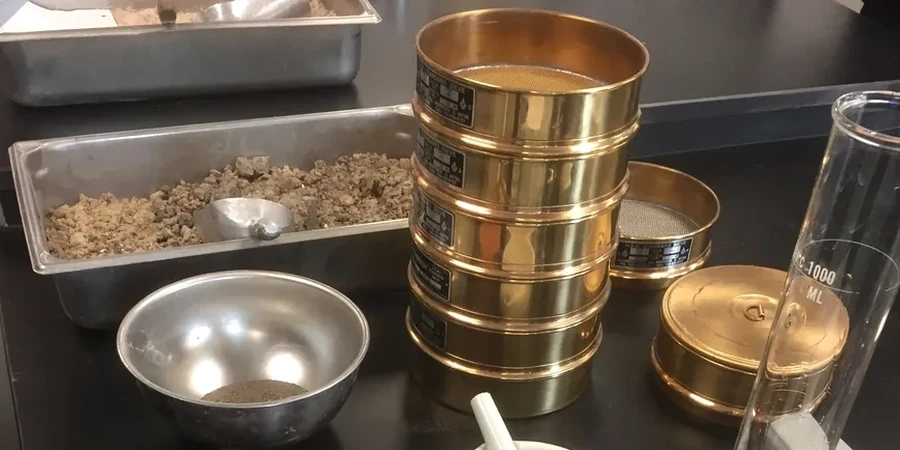
Markham's rapid urbanization onto former farmland means we routinely encounter transitional soil profiles where laminated silts overlie dense till. The contrast between dry summer conditions and the spring thaw saturation cycles demands a testing approach that captures both coarse and fine fractions accurately. Our sieve stack handles everything from gravel down to the No. 200 sieve, while sodium hexametaphosphate dispersion in the hydrometer phase ensures deflocculation of the active clay minerals common in the Peel Plain deposits. For pavement projects along stretches like Major Mackenzie Drive, the gradation result feeds directly into the CBR design for roads process, confirming subgrade suitability under Ontario's freeze-thaw loading. When the silt content exceeds 35%, we recommend supplementing with an in-situ permeability test to verify that lab-measured gradation correlates with actual field drainage capacity, a step that has saved several Markham projects from costly under-slab water issues.
Grain Size Analysis for Geotechnical Projects in Markham, ON
Technical reference image — Markham

Local ground factors

We run the hydrometer test in a controlled 20°C water bath with the 151H soil hydrometer, taking readings over a full 24-hour cycle. The biggest risk we see in Markham projects is misclassification of silty fine sands as free-draining material. When a gradation report shows less than 5% fines but the hydrometer reveals 12% clay-size particles, the design permeability drops by an order of magnitude. This directly impacts footing drainage specifications and can lead to frost heave in unheated structures like parking garages near Markham Centre. Contractors who skip the full hydrometer analysis and rely only on a wash-sieve often face disputes when foundation walls show moisture ingress after the first winter. We've supported litigation cases where the difference between a silt and a clay classification changed the entire retaining wall drainage design.

Need a geotechnical assessment?

Reply within 24h.

Email: info@geotechnicalengineering.co

Reference parameters

ParameterTypical value
Test Method (Coarse Fraction)ASTM D422 / ASTM C136 (Sieve Analysis)
Test Method (Fine Fraction)ASTM D422 / ASTM D7928 (Hydrometer)
Standard Sieve Range75 mm to No. 200 (75 µm)
Hydrometer Analysis Range75 µm to 2 µm (clay fraction)
Dispersing AgentSodium hexametaphosphate solution
Sample Mass (Sieve)500 g to 5 kg depending on max particle size
Test Duration (Hydrometer)Readings at 2, 5, 15, 30, 60, 250, and 1440 minutes
Reporting ParametersD60, D30, D10, Cu (uniformity), Cc (curvature)

Related services

01

Combined Sieve and Hydrometer Package

Full gradation curve from gravel to clay for soil classification per ASTM D2487. Includes uniformity and curvature coefficients. Turnaround in 3-4 business days.

02

Wash Sieve Analysis (Fines Content Only)

Quick determination of minus No. 200 content for compliance checks on granular fill and subbase materials. Commonly requested during compaction testing phases.

Applicable standards

ASTM D422 – Standard Test Method for Particle-Size Analysis of Soils, ASTM C136 – Sieve Analysis of Fine and Coarse Aggregates, Ontario Building Code (OBC) – Structural Design and Soils Provisions, CSA A23.3 – Design of Concrete Structures (Aggregate Requirements)

Frequently asked questions

What's the cost for a full sieve and hydrometer test in Markham?

A complete combined sieve and hydrometer analysis typically runs between CA$140 and CA$270 per sample, depending on whether we need to run the full hydrometer sedimentation curve or just a wash-sieve for fines content. Volume pricing applies for multi-sample projects.

How do I take a representative sample for grain size analysis?

The sample must be at least 500 g for fine-grained soils and up to 5 kg if gravel is present. It should be sealed immediately in a plastic bag to preserve natural moisture. We can provide sampling containers and guidance for your site in Markham.

Why do I need both sieve and hydrometer testing?

The sieve analysis covers particles down to 75 microns, but the hydrometer extends that to 2 microns to capture the clay fraction. In Markham's glacial soils, this clay percentage is what controls frost heave potential and long-term settlement behavior under load.

How do you classify a soil from the grain size curve?

We use ASTM D2487 (Unified Soil Classification System), which combines the grain size distribution with the Atterberg limits. The percentages of gravel, sand, silt, and clay, along with the D60, D30, and D10 values, determine whether the soil is a well-graded sand (SW), lean clay (CL), or another classification.
Location and service area

We serve projects in Markham and surrounding areas.

View larger map