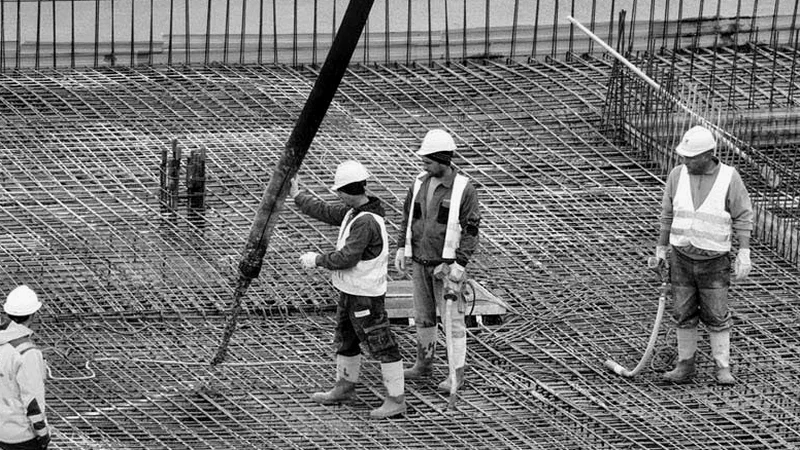
Some firms in Markham still treat a mat foundation like an oversized slab-on-grade, and it costs them later. The city sits on a patchwork of glacial till, sandy interbeds, and pockets of urban fill that shift behavior across a single lot. A proper raft/mat foundation design has to reconcile those contrasts so the whole footprint settles uniformly. A few blocks east of Highway 7 the native Halton Till is stiff, but where the Rouge River carved through, soft alluvium can surprise you. We combine subsurface data with a structural model that respects CSA A23.3 and Ontario Building Code deflection limits, checking both bearing and serviceability before a cubic metre of concrete is poured. When the boreholes show erratic strata, we often recommend a CPT test to fill the gaps between SPT readings and build a continuous stiffness profile that feeds directly into the finite-element mesh.
A mat foundation doesn't just spread load—it bridges weak spots. In Markham's glacial terrain, that bridging capacity often makes the difference between a straightforward permit and a nine-month redesign.
Local ground factors
NBCC 2020 and CSA A23.3 leave no room for guesswork on differential settlement, and Markham's geology makes that clause particularly relevant. The contact between the Halton Till and the underlying glaciolacustrine deposits can be abrupt, sometimes shifting from dense to soft within 15 metres laterally. If the geotechnical model misses that transition, the mat can tilt, crack, or transfer unintended moments into the superstructure. We've seen cases where a mat poured on uncontrolled fill settled 40 mm in the first two wet seasons, triggering structural distress that required underpinning. A proper raft/mat foundation design anticipates these contrasts by modeling the soil-structure interaction explicitly, not just assuming a rigid raft. Seasonal groundwater variation adds another layer: a high water table near the Rouge River corridor reduces effective bearing stress and can induce buoyancy that must be checked for the empty-structure case during spring thaw.
FAQ
What is the typical cost range for a raft/mat foundation design in Markham?
For a residential or light-commercial building, the engineering design phase typically runs between CA$1.380 and CA$6.020, depending on footprint size, number of columns, and whether we need to integrate additional CPT or plate-load data. Complex multi-storey or irregular geometries push toward the upper end because the soil-structure interaction modeling becomes more iterative.
When does a mat foundation make more sense than isolated footings in this region?
A mat becomes the better option when the allowable bearing pressure drops below about 100 kPa, when footings would cover more than half the building footprint, or when the soil profile is so variable that differential settlement is a real concern. In Markham's glacial till, we often see sites where one corner hits dense till at 1.5 metres while the opposite corner sits on 3 metres of softer glaciolacustrine silt—that kind of asymmetry cries out for a mat.
How do you determine the subgrade reaction modulus for a Markham site?
We derive it from field tests—either a plate load test directly on the bearing stratum or by back-calculating from CPT tip resistance and SPT N-values using correlations validated for Ontario tills. The modulus is then adjusted for the mat's dimensions because the classic 'kv' value depends on the loaded area. We also run a sensitivity analysis to bracket the effect of seasonal moisture changes on the upper metre of soil.
Does the Ontario Building Code require a specific settlement limit for mat foundations?
The OBC references NBCC 2020, which sets a total settlement limit of 25 mm and a differential settlement limit of 1/500 of the span for most structures. For raft/mat foundations supporting masonry or brittle finishes, we often tighten the differential criterion to 1/1000 to avoid cracking, and we check both the empty-structure and full-load conditions against those limits.
What site investigation is needed before designing a mat foundation in Markham?
At a minimum, we need boreholes that extend to at least twice the mat width below the bearing level, or until refusal on competent till. In Markham, where the stratigraphy can change quickly, we supplement SPT boreholes with CPT soundings to get a continuous stiffness profile. If the water table is shallow—common near the Rouge River tributaries—we also install a piezometer to track seasonal fluctuations that affect buoyancy checks.