← Home · Investigation

CPT Testing in Markham: Accurate Cone Penetration for Subsurface Profiles

Together, we solve the challenges of tomorrow.

LEARN MORE →

Too many foundation bids in Markham get priced blind. The contractor guesses the stratigraphy based on a 1970s well record and hopes the clay till is competent. Then the excavator hits a soft silt pocket at four meters on the north side of Highway 7 and the change order eats the contingency. That guesswork collapses the moment you run a CPT cone through the deposit. We run the CPT test with a 20-tonne rig that pushes a 60-degree cone at a constant 2 cm/s, logging tip resistance, sleeve friction, and pore pressure every centimetre. The result is a continuous profile that catches those thin compressible seams a split-spoon sampler would miss. For sites near the Rouge River floodplain or the older subdivisions around Main Street Unionville, where lacustrine clays overlie lodgement till, that resolution matters. We pair CPT data with triaxial testing when the project needs drained strength parameters for excavation support design.

A CPT profile in Markham's till will show you the dense layer at depth, but the piezocone dissipation test tells you how fast the overlying clay will drain under load.

Process and scope

The Ontario Building Code references NBCC 2020 for seismic site classification, and CSA A23.3-19 governs concrete structures founded on the soils we characterize. Markham sits in a moderate seismic zone, but the real driver here isn't earthquake shaking—it's the variability of the Halton Till and the interbedded glaciolacustrine deposits. A CPT log gives you a direct measurement of sleeve friction ratio (Rf) that helps distinguish sandy till from clayey silt in real time, something standard penetration testing struggles with in mixed-face conditions. Our piezocone (CPTu) adds dissipation tests to estimate the coefficient of consolidation (cv), a parameter you need when calculating settlement rates under a mat foundation on the compressible clays found east of McCowan Road. We also run seismic CPT downhole for shear wave velocity (Vs) profiles, tying directly into the site class determination without waiting for a separate geophysical crew.
CPT Testing in Markham: Accurate Cone Penetration for Subsurface Profiles
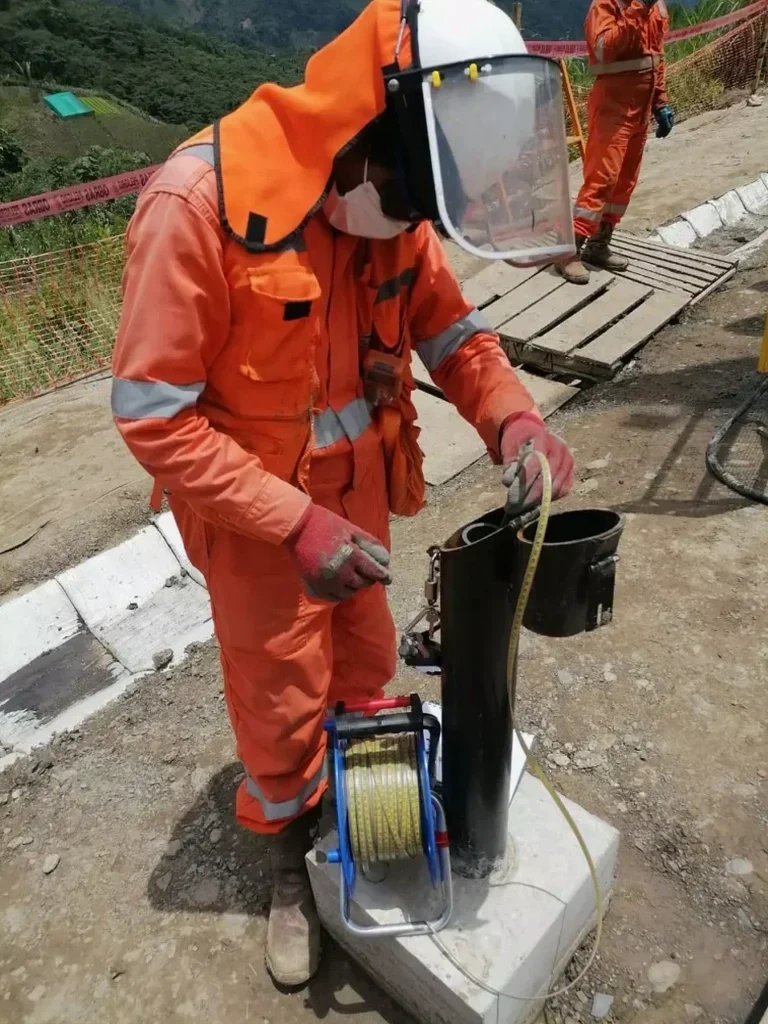
Technical reference image — Markham

Local ground factors

The Oak Ridges Moraine feeds a complex groundwater system into Markham's subgrade. Perched water tables are common in the upper sand layers, and artesian conditions can appear in the deeper aquifers below the till. Running a CPT without pore pressure measurement—just a mechanical cone—leaves you blind to that excess head. We've seen sites near the Rouge watershed where the u2 sensor jumped 60 kPa the moment the cone crossed a silt seam at 11 m depth. Ignore that reading and your excavation shoring plan is based on drained strength when the ground is undrained. The thin-bedded rhythmites in the glaciolacustrine sequence east of Ninth Line also create false refusal problems for SPT; the cone pushes through those pebbly horizons while still capturing the soft clay interbeds that control stability. For deeper infrastructure like the buried utilities crossing Highway 404, missing a low-strength layer can mean differential settlement that cracks a rigid pipe within the first freeze-thaw cycle.

Need a geotechnical assessment?

Reply within 24h.

Email: info@geotechnicalengineering.co

Reference parameters

ParameterTypical value
Cone tip resistance (qc)0.5 to 50+ MPa, depending on material
Sleeve friction (fs)5 to 500+ kPa
Friction ratio (Rf)0.1% to 8%, calculated as fs/qc × 100
Pore pressure (u2)Measured behind cone shoulder, kPa
Penetration rate2.0 cm/s ± 10%, per ASTM D5778
Cone type10 cm² or 15 cm², 60° apex angle
Maximum push depthUp to 25 m in typical Markham overburden
Data intervalContinuous reading every 10 mm

Related services

01

Standard CPTu Profiling

Piezocone penetration with real-time qc, fs, and u2 logging. Includes pore pressure dissipation tests at target depths to estimate consolidation parameters for settlement analysis under footings and mats.

02

Seismic CPT (SCPTu)

Cone equipped with a triaxial geophone for downhole shear wave velocity measurement. Provides Vs profiles for NBCC site class determination (C through E), often required for mid-rise structures in Markham Centre.

03

CPT for Liquefaction Assessment

Targeted pushes in sandy deposits below the water table, processed with the Robertson (2016) method. Used for sites near the Rouge River where loose saturated sands may be present at shallow depth.

Applicable standards

NBCC 2020 (National Building Code of Canada, seismic provisions), CSA A23.3-19 (Design of concrete structures), ASTM D5778-20 (Standard Test Method for Electronic Friction Cone and Piezocone Penetration Testing of Soils), ASTM D6067/D6067M-17 (Standard Practice for Using the CPT for Environmental Site Characterization), Ontario Regulation 332/12 (Building Code, referencing Supplementary Standard SB-6)

Frequently asked questions

How deep can you push the CPT cone in Markham soils?

In the glacial till and lacustrine deposits typical of Markham, we usually reach 20 to 25 meters with a 20-tonne truck-mounted rig. Depth is limited by refusal on dense boulder pavement at the base of the Halton Till, which can stop the cone around 15 to 20 meters in some areas west of Kennedy Road. We adjust push capacity based on sleeve friction feedback and never risk buckling the rods.

What does a CPT test cost for a standard residential lot in Markham?

For a typical single-family lot requiring two to three soundings to 15 meters depth, the cost ranges between CA$240 and CA$300 per sounding, plus mobilization. The total project cost varies with access conditions—tight lots in older neighborhoods like Milliken Mills East may require a smaller rig or additional traffic control, which affects the final quote.

Can CPT replace boreholes for a geotechnical investigation in Markham?

CPT provides excellent continuous soil behavior type data, but it doesn't retrieve physical samples. For most projects, we recommend pairing CPT soundings with at least one or two boreholes to recover Shelby tube samples for laboratory testing. The combination gives you both the high-resolution profile from the cone and the measured index properties and shear strength from the lab, which satisfies the minimum investigation requirements under the Ontario Building Code.
Location and service area

We serve projects in Markham and surrounding areas.

View larger map