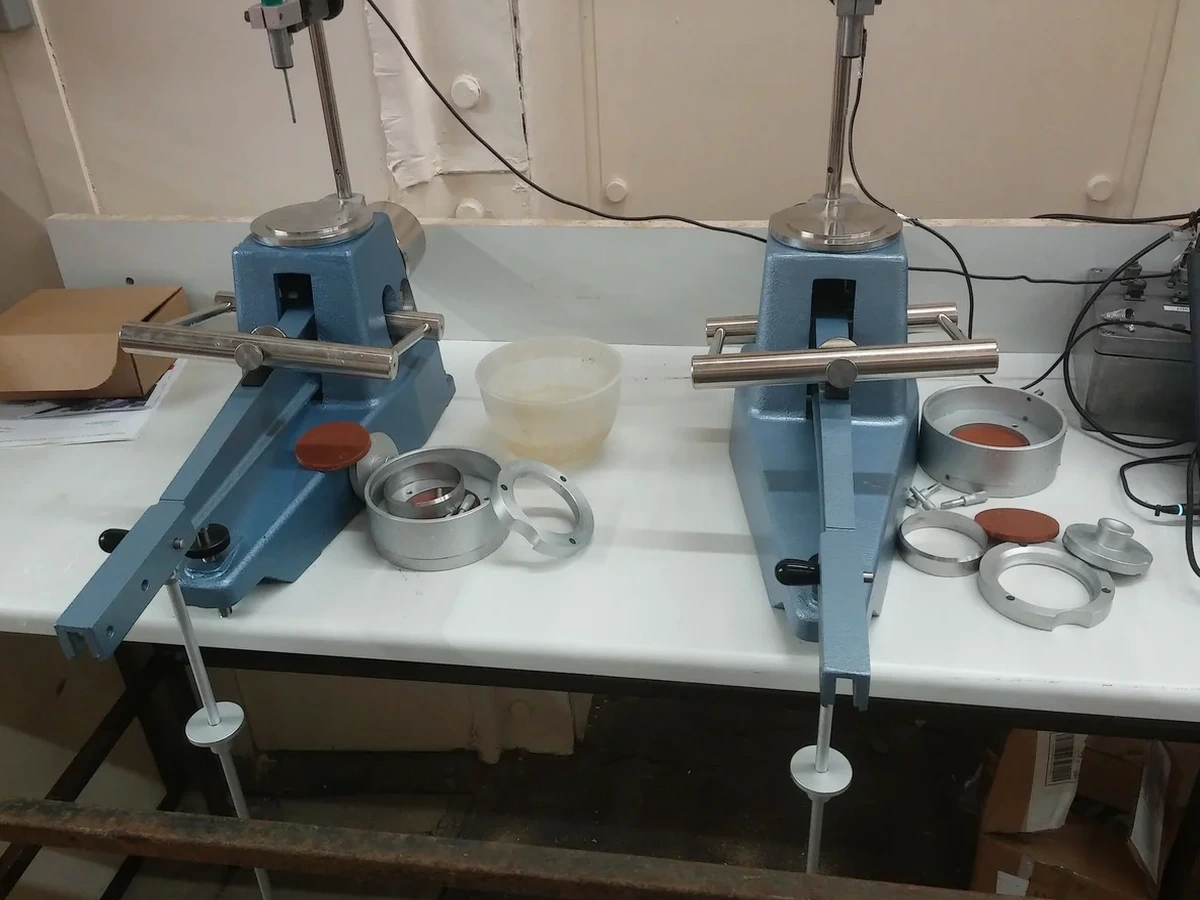
Markham sits on a tricky glacial legacy. The Oak Ridges Moraine left behind pockets of sandy till, but the Rouge River watershed and areas south toward Steeles Avenue are draped in silty clays that can turn from solid to slurry after a few days of rain. When a developer breaks ground near the historic village of Unionville, the first question the geotechnical team asks isn't about bearing capacity—it's about plasticity. That's what Atterberg limits testing answers. By measuring the liquid limit, plastic limit, and plasticity index of a soil sample, we can tell you exactly how your Markham site will respond to seasonal moisture swings. A soil that tests as CL (lean clay) behaves one way under a footing; a CH (fat clay) is a completely different challenge. Getting those numbers right before the foundation is poured saves money and headaches down the road, and we've run these tests on projects from Cornell to Wismer Commons.
A plasticity index above 25% in Markham's Rouge Valley clays is a red flag for volume change potential that no amount of compaction can fix without proper mitigation.
Local ground factors
Around Markham, we frequently encounter sites where the contractor assumed the native soil was a stable till, only to hit a lens of high-plasticity clay that the preliminary desktop study missed. That's the moment when foundation designs need to change—and if the Atterberg limits weren't run before the structural drawings were finalized, the project absorbs a delay that could have been avoided. The real risk isn't just swelling or shrinkage; it's the unplanned cost of redesigning footings, adding moisture barriers, or undercutting and replacing material after excavation has already started. South of Highway 407, where development pressure is intense, skipping this test to save a few hundred dollars can trigger a six-figure remediation down the line. A proper Atterberg limits report gives your structural engineer the data to make informed decisions about slab-on-grade versus pile-supported foundations, and it's standard practice on every project we touch in the Greater Toronto Area.
Reference standards
ASTM D4318 - Standard Test Methods for Liquid Limit, Plastic Limit, and Plasticity Index of Soils, ASTM D2487 - Standard Practice for Classification of Soils for Engineering Purposes (Unified Soil Classification System), CSA A23.3 - Design of Concrete Structures (relevant for foundation design on expansive soils), NBCC 2020 - National Building Code of Canada (referenced for geotechnical investigation requirements)
FAQ
What does the Atterberg limits test actually measure?
It measures the water contents at which a fine-grained soil changes its consistency. The liquid limit is the moisture content where the soil starts to flow like a liquid; the plastic limit is where it crumbles when rolled into a 3 mm thread. The difference between the two is the plasticity index, which tells us how sensitive the soil is to moisture changes.
How much does Atterberg limits testing cost in Markham?
For a standard set of Atterberg limits on one sample—liquid limit, plastic limit, and plasticity index—you're looking at a range of CA$80 to CA$120. That price can vary slightly depending on the number of samples and whether we're also running a grain size analysis on the same material.
Do I need Atterberg limits if I already have a borehole log?
A borehole log gives you soil descriptions and SPT blow counts, but it doesn't tell you how the clay will behave when it gets wet. Atterberg limits quantify that behavior. If your Markham site has any fine-grained material—and most do—you want those numbers before finalizing foundation depths or pavement designs.
How many samples should I test for a typical Markham building lot?
It depends on the soil variability, but we typically recommend at least one Atterberg limits test per distinct soil layer encountered in the borehole. For a single-family lot with 2 to 3 boreholes, that usually means 4 to 6 samples to capture the range of plasticity across the site.
What's the difference between CL and CH clay in practical terms for my project?
CL clays have a plasticity index below about 30% and tend to be more manageable with standard footing designs. CH clays—the fat clays with PI above 30%—are the ones that swell, shrink, and cause foundation movement. In Markham's Rouge Valley corridor, we see CH clays frequently enough that we flag them immediately when the PI comes back high.