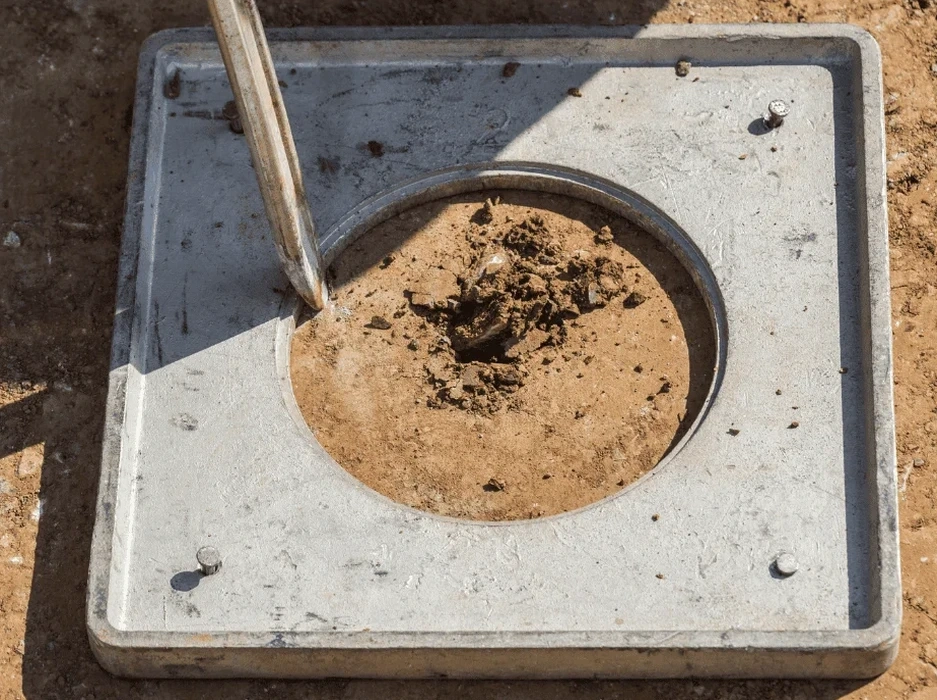
The geotechnical contrast between Markham's historic Rouge River floodplain and the elevated glacial till plains east of Highway 48 defines the seismic risk profile for any major construction project. Where the older village core near Main Street sits on dense Halton Till, the newer developments sprawling toward Cornell and Cathedraltown often encounter layers of loose saturated sand and silty sand deposited by ancestral Lake Ontario. These granular deposits, when subjected to earthquake shaking, can lose effective stress and behave as a viscous fluid—a phenomenon known as soil liquefaction. A site-specific CPT testing program provides continuous penetration resistance data that feeds directly into the cyclic stress ratio calculations required by NBCC 2020, while complementary borehole logging via SPT drilling recovers samples for fines content verification in the laboratory.
A thin silt seam within a sand unit can double the time required for pore pressure dissipation—altering the liquefaction hazard from marginal to critical.
FAQ
At what depth is liquefaction most likely to occur in Markham soils?
Liquefaction typically manifests within the upper 15 to 20 meters of loose, saturated granular deposits. In Markham, the critical zone often lies between 3 and 12 meters depth, corresponding to post-glacial sand units within the Rouge River paleochannel and localized kettle-fill deposits. Deeper Pleistocene till is generally non-liquefiable due to its high density and overconsolidation. We always extend site investigation to at least 20 meters or refusal to ensure no loose layer is missed.
What is the difference between a deterministic and a probabilistic liquefaction analysis?
A deterministic analysis uses a single design earthquake scenario (e.g., M7.0 at 50 km) and computes a factor of safety at each depth. A probabilistic analysis, informed by the NBCC 2020 seismic hazard deaggregation, incorporates the full distribution of earthquake magnitudes and distances to compute the annual probability of liquefaction triggering. The probabilistic approach aligns with performance-based design and allows the structural engineer to select an acceptable risk level.
How much does a liquefaction analysis cost for a residential project in Markham?
For a standard residential lot in Markham, a complete liquefaction assessment—including field investigation (CPT or SPT borings), laboratory index testing, and engineering analysis—typically ranges from CA$3,670 to CA$5,750. The final cost depends on the number of test points, depth of investigation, and whether cyclic laboratory testing is required. We carry out a detailed proposal after reviewing the site plan and available geotechnical data.
Does the presence of clay layers eliminate liquefaction risk?
Not necessarily. While cohesive clay layers themselves are not liquefiable, they can act as confining caps that impede pore pressure dissipation from underlying sand layers. This can extend the duration of elevated pore pressure and increase the risk of delayed failure or excessive settlement. Our analysis models the coupled consolidation response to capture this effect, following the framework outlined in the Canadian Foundation Engineering Manual.
What ground improvement methods are suitable for liquefiable soils in Markham?
The most common techniques for Markham's sand and silty sand deposits include vibrocompaction for clean sands up to 15 meters depth, stone columns for silty sands where drainage is also required, and compaction grouting for sites with limited access where vibration must be minimized. The selection depends on the gradation, fines content, depth of the liquefiable layer, and proximity to existing structures. Our analysis quantifies the required post-treatment density to achieve the target factor of safety.