← Home · Ground improvement

Stone Column Design in Markham: Ground Improvement for Compressible Soils

Together, we solve the challenges of tomorrow.

LEARN MORE →

Part 4 of the Ontario Building Code, referencing the National Building Code of Canada (NBCC), sets clear expectations for foundation performance on marginal ground. In Markham, where pockets of glaciolacustrine clay and silt dominate the subsurface south of Highway 7, traditional shallow footings often hit a wall, literally and figuratively. The Don River watershed corridor, which cuts through the city’s east side, compounds the challenge with water tables sitting barely two meters below grade. Stone column design steps in when excavation and replacement becomes impractical, offering a vibro-replacement path that densifies the matrix and creates vertical drains. A proper grain size analysis of the native soil is the first filter to confirm that fines content won't choke the stone column's drainage function, while site-specific CPT testing maps the undrained shear strength profile needed to size the columns.

A well-designed stone column grid in Markham's soft clay can cut post-construction settlement by 60 to 80 percent compared to untreated ground.

Process and scope

We recently reviewed a low-rise commercial project off Woodbine Avenue where the geotechnical report showed 9 meters of soft, slightly overconsolidated silty clay with Su values below 35 kPa. The structural engineer had specified a net bearing pressure of 150 kPa, a number that simply wouldn't work on untreated ground. The team modeled a grid of 800 mm diameter stone columns at 2.1 meter spacing, targeting a composite friction angle above 38 degrees. Load transfer platforms are often overlooked, but here the design integrated a high-strength geotextile and a 600 mm granular mattress to arch the slab loads. For deeper liquefiable layers east of the Rouge River, combining stone columns with vibrocompaction can pre-densify the sand before column installation, a sequence that makes a measurable difference in SPT blow counts. The column length was terminated at the glacial till refusal, and settlement estimates dropped from 65 mm to under 20 mm.
Stone Column Design in Markham: Ground Improvement for Compressible Soils
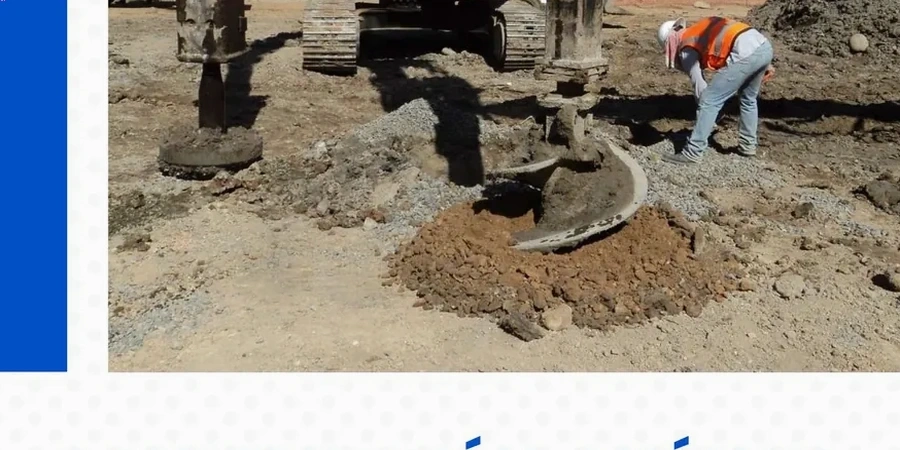
Technical reference image — Markham

Local ground factors

Markham sits on the northern flank of the Greater Toronto Area's seismic zone, classified under NBCC 2020 with a uniform hazard spectrum that peaks around 0.35g for the 2% in 50-year event. The city's glacial geology, mapped extensively by the Ontario Geological Survey, reveals thick sequences of Halton Till overlying glaciolacustrine rhythmites, with pockets of organic silt near the historic Rouge River floodplain. Installing stone columns without a proper in-situ permeability assessment in these silty zones risks creating pore pressure build-up during vibroflot withdrawal. The biggest headache we see is differential settlement between column-supported areas and adjacent untreated zones; a gradual transition taper over three to four column rows usually solves it. Stone column design in Markham must also account for frost depth at 1.2 meters, ensuring the granular mattress extends below the frost line to prevent heave that would crack the slab.

Need a geotechnical assessment?

Reply within 24h.

Email: info@geotechnicalengineering.co

Reference parameters

ParameterTypical value
Typical column diameter600 – 1,200 mm
Area replacement ratio10% – 35%
Target composite friction angle36° – 42°
Maximum treatment depthUp to 20 m (vibroflot-dependent)
Load transfer platform thickness400 – 800 mm
Post-treatment settlement tolerance< 25 mm (typical)
Design life50 – 75 years (permanent works)

Related services

01

Feasibility and Settlement Analysis

We run axisymmetric finite element models and Priebe method calculations to estimate composite modulus, stress concentration ratios, and total settlement under structural loads.

02

Vibro-Replacement Specification

Detailed construction specs covering stone gradation (typically 25–75 mm clean crushed rock), vibroflot power requirements, and step-by-step installation sequence.

03

Post-Installation Load Testing

We design and supervise single-column load tests and zone load tests with multi-point settlement monitoring to validate the design assumptions.

Applicable standards

NBCC 2020 (National Building Code of Canada), CSA A23.3 Design of Concrete Structures, ASTM D4123 Tensile Characteristics of Bituminous Pavement, OPSS 1010 Aggregates – Base, Subbase, Select Subgrade, Ontario Building Code – Supplementary Standard SB-1

Frequently asked questions

How much does stone column design cost for a Markham project?

For a typical commercial or industrial building in Markham, the engineering design package — including geotechnical interpretation, stone column modeling, construction specifications, and QA/QC oversight — ranges from CA$2,050 to CA$6,890. The spread depends on the treated area, number of columns, and depth of the soft layer. A 1,500 m² footprint with 8 to 12 meters of soft clay will land near the middle of that range.

What soil types in Markham are best suited for stone columns?

Stone columns perform well in the soft to firm silty clays and clayey silts common to Markham's glaciolacustrine plain, particularly where the undrained shear strength is at least 15 to 20 kPa. They also work in loose silty sands where vibrocompaction alone may not achieve the target density. Sites with thick organic deposits or peat, such as filled-in wetlands near the Rouge River headwaters, usually require a different approach or excavation and replacement before column installation.

What's the difference between stone columns and vibrocompaction?

Vibrocompaction densifies granular soils by rearranging particles under vibration without adding stone. Stone columns, by contrast, actually displace soft cohesive soil and replace it with a compacted granular column. In Markham's mixed stratigraphy — where sand lenses alternate with silty clay — we often use a combination: vibrocompaction for the sandy zones and stone columns for the cohesive pockets, all within the same treatment grid.

How long does the design process take from field investigation to final drawings?

A realistic timeline for a Markham project runs about four to six weeks. The first two weeks cover the CPT and test pit campaign to map the soft layer thickness and water table. Modeling and design take another two weeks, and the final week covers review, drafting of construction specs, and coordination with the structural engineer. Projects requiring a peer review or municipal permit add roughly one extra week.
Location and service area

We serve projects in Markham and surrounding areas.

View larger map