← Home · Slopes & Walls

Active & Passive Anchor Systems — Design for Markham Glacial Soils

Together, we solve the challenges of tomorrow.

LEARN MORE →

Markham sits on the South Slope physiographic region — a blanket of glacial till overlying the Georgian Bay Shale, interrupted by deep valleys carved into Halton clay. Any excavation beyond 3.5 m in the Rouge River corridor encounters stiff to very stiff clay with shear strengths that degrade fast once the natural moisture content shifts. We design active anchors that preload the bond zone before the wall moves, and passive anchors that engage progressively as the soil mass deforms. The distinction matters here because winter frost reaches 1.2 m and spring saturation drops the undrained shear strength by 30–40 % in weathered till. Our bond-length calculations follow the slope stability framework for long-term load transfer, and when the till contains cobble-sized clasts we verify refusal depth with SPT drilling before finalizing the drill-and-grout sequence.

A restressable anchor is the only tieback system that lets you correct lock-off loss after a Markham spring thaw — and that single adjustment can save a shoring wall from serviceability failure.

Process and scope

Markham's weather swings from minus-25 °C in February to plus-33 °C in July — a 58-degree range that stresses every component of a permanent anchor system. We specify double-corrosion protection (DCP) as standard: corrugated HDPE duct over epoxy-coated strand, with the annulus pressure-grouted in two stages. The first-stage grout fills the bond zone in the intact shale below the weathered crust; the second-stage grout, injected 24 hours later, seals the free-stressing length through the overburden. On a recent Highway 7 mixed-use project we combined this anchor layout with in-situ permeability testing in the bond zone to confirm that hydraulic conductivity stayed below 1 × 10⁻⁷ cm/s — critical for preventing grout washout in fractured shale. For temporary shoring in the Cornell Centre area, where the till is sandier, we often pair passive anchors with a CPT test profile to map the exact depth of the dense lodgement till, reducing the unbonded length by 1.5 m and cutting steel tonnage without sacrificing factor of safety.
Active & Passive Anchor Systems — Design for Markham Glacial Soils
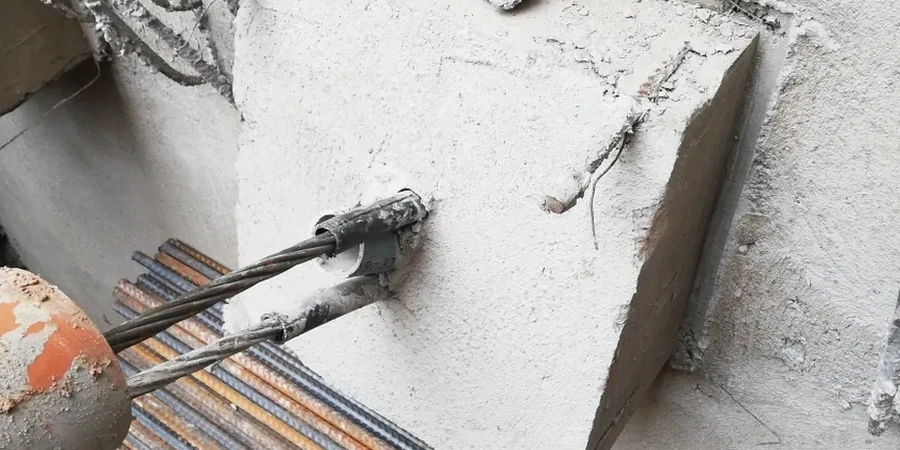
Technical reference image — Markham

Local ground factors

The 2015 Ontario Building Code (OBC, referencing NBCC 2015) places Markham in seismic category C with a spectral acceleration Sa(0.2) of 0.33 g. For a tied-back wall supporting a public right-of-way, that translates into a post-earthquake serviceability check that passive anchors alone often fail because the wedge displacement exceeds 50 mm. We have pulled proof-test data from three Rouge Bank commercial excavations where passive strand anchors lost 18 % of lock-off load after a wet March, simply because the clay pore pressure equalized around the grout bulb. Active restressable anchors eliminate that decay: the stressing head stays accessible behind a removable cover, and we retension in under two hours. Ignoring the hydrogeologic cycle is the single costliest shortcut an owner can take on a Markham deep dig.

Need a geotechnical assessment?

Reply within 24h.

Email: info@geotechnicalengineering.co

Video resource

Reference parameters

ParameterTypical value
Design bond stress (Halton clay, stiff)80 – 140 kPa (FHWA GEC No. 4 method)
Design bond stress (lodgement till, dense)200 – 350 kPa (pressure-grouted)
Free-stressing length minimum4.5 m behind critical failure surface
Tendon type15.2 mm Ø 7-wire strand (CSA G279, Grade 270)
Corrosion protection classDouble (DCP) per PTI DC-35.1-14
Proof-test load133 % of design load (CSA A23.3 Annex A)
Creep criterion (passive anchors)< 2 mm over 60 min at lock-off
Typical bonded length in shale4.0 – 6.5 m (depending on RQD)

Related services

01

Active Tieback Design & Restressable Systems

Full submittal package with bond-length calculations per FHWA GEC No. 4, double-corrosion detailing, and stressing sequence. We design the anchor head to remain accessible for retensioning after seasonal pore-pressure equalization.

02

Passive Anchors for Temporary Shoring

Cost-effective strand or bar anchors for cuts up to 8 m in competent lodgement till. Design relies on progressive mobilization; we set the unbonded length using CPT refusal data to keep the wedge within the dense till zone.

03

Proof Testing & Lift-Off Verification

On-site supervision of performance tests (creep, extended creep, cyclic) per CSA A23.3 Annex A. We run lift-off checks on existing anchors to quantify lock-off loss before remedial work begins.

Applicable standards

CSA A23.3: Design of Concrete Structures (Annex A — Ground Anchors), PTI DC-35.1-14: Recommendations for Prestressed Rock and Soil Anchors, OBC 2015 / NBCC 2015 — Seismic Hazard for Markham (Sa(0.2) = 0.33 g, Site Class C/D), FHWA GEC No. 4: Ground Anchors and Anchored Systems (accepted by MTO)

Frequently asked questions

What is the difference between active and passive anchors for a Markham excavation?

Active anchors are tensioned to a specified lock-off load immediately after the grout reaches strength — the wall doesn't need to move for the anchor to carry load. Passive anchors only engage once the soil mass deforms and transfers pressure to the tendon. In Markham's Halton clay, where spring saturation can soften the upper 2 m, active anchors prevent the initial 15–25 mm of wall movement that a passive system requires, keeping adjacent utilities within settlement tolerances.

How much does anchor design and testing cost in Markham?

For a typical tied-back wall with 30–60 anchors, the design, submittal, and on-site proof-testing package ranges from CA$1,400 to CA$5,180 depending on the number of anchor types, corrosion protection class, and whether cyclic testing is required by the geotechnical review board. This does not include the drilling and grouting labor, which is quoted separately by the contractor.

Which corrosion protection level does the Ontario Building Code require?

The OBC references CSA A23.3 Annex A, which mandates double corrosion protection (DCP) for permanent anchors and for temporary anchors with a service life exceeding 24 months. DCP uses a corrugated HDPE duct over epoxy-coated strand with two-stage grouting. In Markham's granular till, where groundwater can carry dissolved oxygen, we specify DCP even for 18-month temporary shoring when the anchor passes under a public road.

How is bond length verified in Markham's glacial till?

We combine CPT or SPT refusal data with a sacrificial anchor test at the start of production drilling. The bond zone is pressure-grouted at 350–700 kPa, and a 60-minute creep test at 133 % of design load confirms that creep is below 2 mm. If the till contains cobbles that cause grout loss, we switch to a post-grouting technique through a tube-à-manchette sleeve, re-injecting 4–6 hours after the primary grout sets.
Location and service area

We serve projects in Markham and surrounding areas.

View larger map