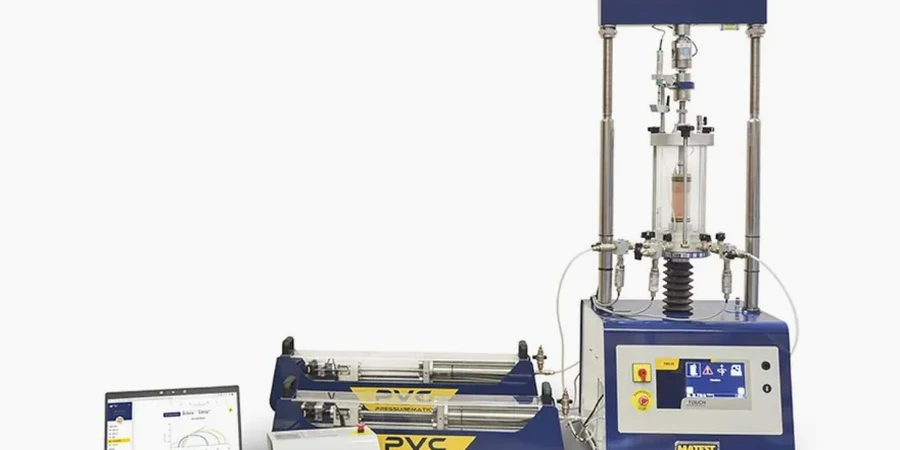
Markham sits at roughly 200 meters above sea level, draped over a complex sequence of glacial till, silty clay, and occasional sandy lenses left by the Wisconsin glaciation. When a project here goes deeper than a few meters—whether it’s a mid-rise along Highway 7 or a cut-and-cover utility trench near the Rouge River—the soil doesn’t behave like textbook sand or clay; it’s an overconsolidated mixture that demands precise strength parameters. The triaxial test provides those numbers: effective cohesion (c’), effective friction angle (φ’), and undrained shear strength (Su) under controlled drainage conditions. On a recent investigation near the German Mills Creek area, the team ran a consolidated-undrained triaxial test with pore pressure measurement on a stiff clay sample recovered at 8 meters depth, and the resulting friction angle shifted the shoring design from a soldier pile wall to a more economical anchored system. That’s the kind of impact a well-executed triaxial test delivers in Markham’s variable subsurface.
Effective stress parameters from a CU triaxial test often reduce required shoring embedment by 15 to 20 percent compared to conservative total stress assumptions.
Local ground factors
Markham’s freeze-thaw cycles, combined with spring snowmelt, create a near-surface saturation zone that temporarily elevates pore pressures in the upper 2 to 3 meters. If triaxial testing is performed only on dry-season samples, the effective stress parameters can be unconservatively high. The real risk shows up during excavation in late March, when a shoring wall designed with summer friction angles may expertise larger-than-expected lateral deflections. We recommend sampling during the wet season, or at minimum applying a reduced effective stress envelope for the upper weathered crust. The contrast between the stiff Halton Till and the softer, glaciolacustrine clays found in the eastern part of the city also means a single triaxial test at one depth is insufficient; a profile of at least two to three sampling depths captures the strength transition that governs base stability in deep excavations.
FAQ
What does a triaxial test cost in Markham?
A complete three-specimen CU triaxial suite with pore pressure measurement typically ranges between CA$2,440 and CA$3,230, depending on specimen preparation complexity and required confining pressure range. Soils with gravel or cobbles that require larger-diameter specimens fall at the upper end of the range.
How long does a triaxial test program take from sampling to report?
A three-specimen CU triaxial test with full saturation, consolidation, and shear phases usually takes three to five working days. Including sample extrusion, trimming, and final reporting, expect seven to ten business days. UU tests are faster, often completed in two to three days.
Which triaxial test type is appropriate for Markham’s Halton Till?
For permanent works, a consolidated undrained (CU) test with pore pressure measurement per ASTM D4767 is recommended because it yields effective stress parameters (c' and φ') that account for the till’s overconsolidated nature. For temporary excavation stability, a UU test may supplement the CU data to carry out total stress strength for short-term conditions.