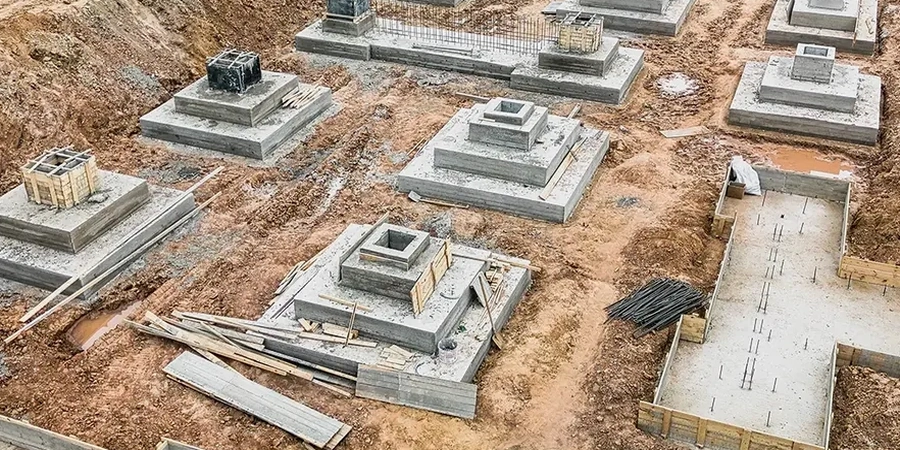
Markham sits on a deceptively complex glacial legacy. The Oak Ridges Moraine to the north and the South Slope physiographic region under the city mean subsurface conditions shift abruptly: dense Halton Till gives way to sand lenses, silt pockets, and buried valleys carved by ancient meltwater channels. When you propose a structure here, pile foundation design becomes an exercise in reading that glacial history. A boring 200 meters east can hit stiff till at 12 meters while the next one finds 25 meters of compressible sediment before bearing stratum. The Rouge River watershed adds another variable: groundwater levels that fluctuate seasonally and soften the upper till crust. In our expertise, treating Markham as uniform ground is the quickest way to trigger pile performance problems down the line. Every pile foundation design we develop starts with a stratigraphic model that respects this variability, because the last thing any project needs is a pile group where half the elements behave differently than predicted.
Markham's glacial till is not a uniform bearing layer; its fissured fabric demands a pile design calibrated to site-specific skin friction, not regional averages.
Process and scope
What we consistently observe across Markham's commercial and residential corridors is that pile foundation design demands a site-specific skin friction model. The Halton Till, while dense, exhibits a fissured macro-structure that can produce erratic shaft resistance, particularly when it transitions from desiccated near-surface conditions to saturated depth.
A standard design based solely on SPT N-values often underestimates this variability. We routinely pair deep boreholes with in-situ testing to calibrate unit side friction and end-bearing parameters. The interaction between pile type and till matrix matters enormously. Augered cast-in-place piles, driven H-piles, and micropiles each mobilize the till differently. In our view, pile foundation design in Markham is less about selecting a pile type from a catalog and more about matching the installation effect to the soil fabric. We also see repeated challenges in the eastern reaches of the city, where the till thins and glaciolacustrine deposits become dominant. There, negative skin friction from consolidating silt becomes the controlling design case, and ignoring it leads to settlements that exceed serviceability limits within the first two years of building occupation. A solid pile foundation design here integrates consolidation testing of the cohesive layers to quantify downdrag loads before a single pile is ordered.
Local ground factors
The buried valley systems beneath Markham represent the single largest geotechnical risk to deep foundations. These features, mapped by the Ontario Geological Survey, are filled with sequences of silt, sand, and soft clay that can extend tens of meters below the surrounding till surface. A pile foundation design that assumes a continuous bearing layer at a uniform depth will fail if it intersects one of these paleochannels. The consequence is differential settlement within the pile group, sometimes severe enough to tilt structural frames and crack slab-on-grade connections.
Another risk we track closely is pile heave during construction. In the dense till matrix, driving displacement piles can lift adjacent piles if the group spacing is tight and the installation sequence is not managed. We have seen cases where heave exceeded 15mm on corner piles, permanently altering load distribution. A comprehensive pile foundation design in Markham must address both the regional geological hazard of buried valleys and the construction-phase risk of installation-induced soil movement. These are not theoretical concerns; they are conditions we encounter and mitigate regularly through instrumented pile load testing that validates the design assumptions before production piling begins.
FAQ
How much does pile foundation design cost for a typical Markham project?
Pile foundation design for a mid-size commercial or multi-residential building in Markham typically ranges from CA$2,050 to CA$9,790, depending on the number of boreholes, the complexity of the soil profile, and whether instrumented load testing is included. A straightforward design with two to three deep boreholes and a standard axial capacity report falls at the lower end. Projects involving buried valley investigation, lateral load analysis, or dynamic pile monitoring move toward the upper range.
What makes Markham's soil conditions different from other GTA municipalities for deep foundations?
Markham lies across the transition between the Oak Ridges Moraine and the South Slope, creating a more heterogeneous till cover than what you find in Toronto or Mississauga. Buried valleys cut through the till in several corridors, and the Rouge River watershed introduces perched groundwater that softens the upper till. This means pile foundation design here cannot rely on the regional bearing-depth assumptions that work elsewhere; each site must be individually profiled and the pile capacity model calibrated to local stratigraphy.
Do you perform pile load tests, and why are they necessary?
Yes, static pile load testing is a standard part of our design validation process in Markham. Because the Halton Till is fissured and variable, SPT-based capacity predictions alone carry too much uncertainty for production pile design. A preliminary test pile, instrumented with strain gauges along its length, gives us the actual unit skin friction in each soil layer and the true end-bearing response. We use that data to optimize the final pile lengths and avoid both under-design and costly over-conservatism.