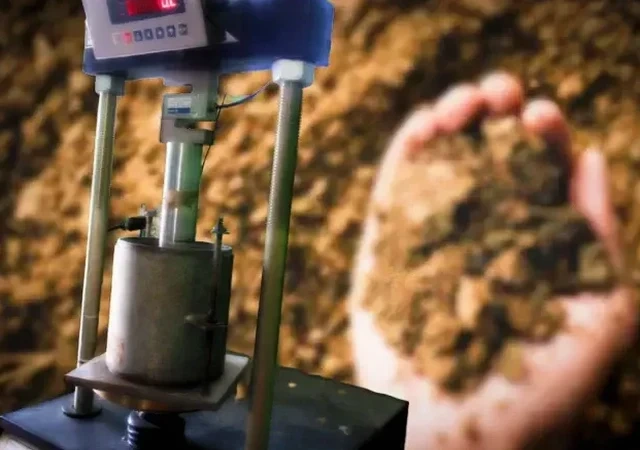
Subgrade evaluation in Markham demands more than a simple density check. The Ontario Building Code references ASTM D1883 as the standard method for California Bearing Ratio, and our laboratory follows this protocol rigorously—including both soaked and unsoaked conditions. Markham's post-glacial landscape, with its mix of Halton Till overlying shale bedrock near the Rouge River valley, creates variable bearing capacity that a field density test alone cannot capture. A properly executed in-situ permeability test often reveals drainage deficiencies in these silty clays, which directly influence the soaked CBR value. Our team manages the full cycle: sample extrusion from Shelby tubes, moisture conditioning at the compaction curve's optimum, four-day soaking with swell measurement, and penetration resistance at 0.05 inches per minute. We report CBR at 0.1-inch and 0.2-inch penetration, corrected for surface irregularities when needed, and always include the stress-penetration curve so the design engineer can verify the maximum dry density relationship.
Soaked CBR on Markham's Halton Till can drop from 22% to under 4% after four days of saturation—design for the worst-case spring condition.
Local ground factors
Two sites on opposite sides of McCowan Road can produce entirely different CBR curves. A residential lot near Toogood Pond, underlain by the organic-rich Postglacial deposits mapped by the Ontario Geological Survey, often yields soaked CBR below 2%—demanding a full-depth asphalt section or aggregate replacement. Half a kilometer west, a parking lot on the Halton Till plain might test above 15% soaked and only need a thin granular base. Skipping the laboratory soak cycle risks designing pavement for summer stiffness that disappears during the March thaw. The MTO Pavement Design and Rehabilitation Manual ties granular base thickness directly to soaked CBR, and a 1% difference in CBR below 5% can add 50 mm of Granular A. On Highway 7 widening projects, we have seen the CBR threshold dictate whether the contractor can proof-roll or must undercut and replace. For deeper infrastructure like buried utilities crossing the Little Rouge Creek corridor, a CPT test provides continuous tip resistance and sleeve friction data that correlate well with the lab-derived bearing capacity, giving the trench designer a full profile from pavement to bedrock.
Reference standards
ASTM D1883-21: Standard Test Method for California Bearing Ratio (CBR) of Laboratory-Compacted Soils, ASTM D1557-12(2021): Standard Test Methods for Laboratory Compaction Characteristics of Soil Using Modified Effort, MTO LS-702: Method of Test for California Bearing Ratio of Soils, OPSS.MUNI 1010: Material Specification for Aggregates – Base, Subbase, Select Subgrade, and Backfill Material
FAQ
What is the difference between soaked and unsoaked CBR, and which one should I use for a Markham parking lot?
Unsoaked CBR represents the subgrade strength at the compaction moisture content, typically tested right after molding. Soaked CBR simulates the worst-case scenario after prolonged saturation—critical in Markham where spring snowmelt and the low-permeability Halton Till trap water at the subgrade interface. For a parking lot with asphalt pavement, the MTO Pavement Design Manual requires the soaked value at the design compaction density. We recommend running both when the water table is within 1.5 meters of the subgrade elevation, because the swell percentage during soaking also tells you whether the clay will heave under an impermeable pavement surface.
How much does a laboratory CBR test cost in Markham?
A single-point CBR test (one moisture content, three specimens for reproducibility) ranges from CA$180 to CA$260, depending on whether we run the full compaction curve first. A complete three-point CBR program—three molding moisture contents with compaction curves and soaked penetration—typically runs between CA$280 and CA$330. If stabilization is involved, the cost varies with the number of binder dosages and curing periods. Turnaround is 7 to 10 business days due to the four-day soak cycle plus compaction curve preparation.
Can you test CBR on samples taken from a test pit instead of a borehole?
Yes, bulk samples collected from test pits are perfectly suitable for remolded CBR testing, provided the sample mass is sufficient—we need at least 25 kg of material passing the 19 mm sieve to run a full three-point program. The key is that the sample must represent the actual subgrade material, not the topsoil or fill. We coordinate with the excavation contractor to ensure the sample is taken from the design subgrade elevation and sealed in plastic to preserve its natural moisture content until compaction. For undisturbed strength, Shelby tubes from boreholes are preferred.
What CBR value does the City of Markham require for residential street subgrades?
The City of Markham generally follows the MTO and Ontario Provincial Standard Specifications, which call for a minimum soaked CBR of 3% to 5% for local residential streets, depending on the pavement structure and traffic loading. Many subdivision agreements specify a granular subbase thickness based on the soaked CBR measured at 95% of Standard Proctor maximum dry density. If the lab CBR is below 3%, the typical remediation is undercutting 300 to 600 mm and replacing with engineered fill, or stabilizing with 3% to 5% Portland cement. The exact threshold should be confirmed in the geotechnical terms of reference for the specific subdivision.