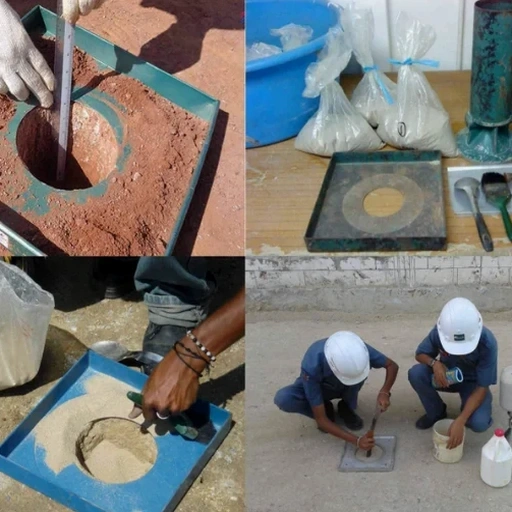
The glacial history of the Rouge River watershed left Markham with a complex mantle of silty clay till, stony Halton Till, and occasional ice-contact stratified drift. When summer humidity saturates the upper crust and winter freeze-thaw cycles loosen the top 600 mm, achieving 98% Standard Proctor on a subdivision off Major Mackenzie Drive is not a given — it is a negotiation with the soil’s memory of the last ice advance. Our field density testing using the sand cone method gives contractors a direct measurement of in-place wet density and moisture content within the lift, calibrated against the same proctor curve the project’s earthworks spec requires. Because Markham’s building department now ties occupancy permits to third-party compaction reports on engineered fill, skipping a proper sand cone density test on the structural fill beneath a parking garage slab can hold up a certificate of completion for weeks. We run the test to ASTM D1556 and CSA A23.3 protocols, with a calibrated Ottawa sand gradation that accounts for the slight angularity of crushed granular B imported from quarries near Stouffville.
In Markham’s glacial tills, a 2% drop in relative compaction below spec can reduce the drained friction angle by 3 degrees — enough to shift a footing from safe to settlement-critical.
Local ground factors
Ontario Regulation 332/12 under the Building Code Act places explicit responsibility on the designer and the geotechnical reviewer to confirm that engineered fill meets the compaction criteria specified in the geotechnical report. In Markham, where the water table rises seasonally within the upper 3 metres across much of the former agricultural land between McCowan Road and Ninth Line, under-compacted structural fill becomes a direct pathway for post-construction settlement and differential movement beneath slab-on-grade foundations. The sand cone test provides the only direct, disturbance-free measurement of field density that does not rely on nuclear source licensing, which means smaller contractors can request a test without the logistical headache of a nuclear gauge operator on site. When a test pit reveals wet, soft clay at subgrade level, we typically recommend undercutting and recompaction with imported granular B, verified lift by lift with the sand cone — a sequence that has prevented floor slab cracking in several Markham industrial units where the original site grading report underestimated the moisture sensitivity of the native till.
FAQ
What does a sand cone density test cost in Markham?
For a single lift with one test location within Markham, the fee typically ranges from CA$160 to CA$170, including the field density determination, moisture content from the same hole, and a signed report with the relative compaction calculated against the project’s proctor curve. Mobilization for multiple lifts on the same day reduces the per-test cost.
How long does a sand cone test take on site?
From setting the base plate to excavating the hole, collecting the material, pouring the sand, and backfilling, a single test takes approximately 20 to 30 minutes. The moisture content determination adds about 24 hours if done by oven drying in the lab, but we can carry out a field moisture estimate using a gas stove or microwave method within 45 minutes on site for immediate pass/fail decisions.
How does the sand cone method compare to a nuclear density gauge?
The sand cone method measures density directly by volume displacement, so it does not need calibration against the specific soil mineralogy — a significant advantage in Markham’s tills where variable iron content affects nuclear gauge readings. The trade-off is speed: a nuclear gauge delivers results in minutes, while the sand cone requires excavation and careful sand pouring, but the sand cone remains the referee method in Ontario when nuclear results are disputed because it is a primary measurement traceable to mass and volume standards.
What compaction standard applies to Markham residential subdivisions?
Most residential subdivisions in Markham specify 98% of Standard Proctor maximum dry density (ASTM D698) for structural fill within the foundation footprint and 95% for general site grading outside the building envelope. The town’s building department enforces OPSS.MUNI 206 frequency requirements, which typically means one density test per 500 square metres per lift, or one test per lot per lift for individual residential lots with engineered fill.